Optimizing Your Workspace and Initial Organization
Tackling a standard 1000-piece jigsaw puzzle presents a rewarding test of spatial reasoning, patience, and visual endurance. Shaving hours off your completion time comes down to methodical preparation rather than frantic guesswork.
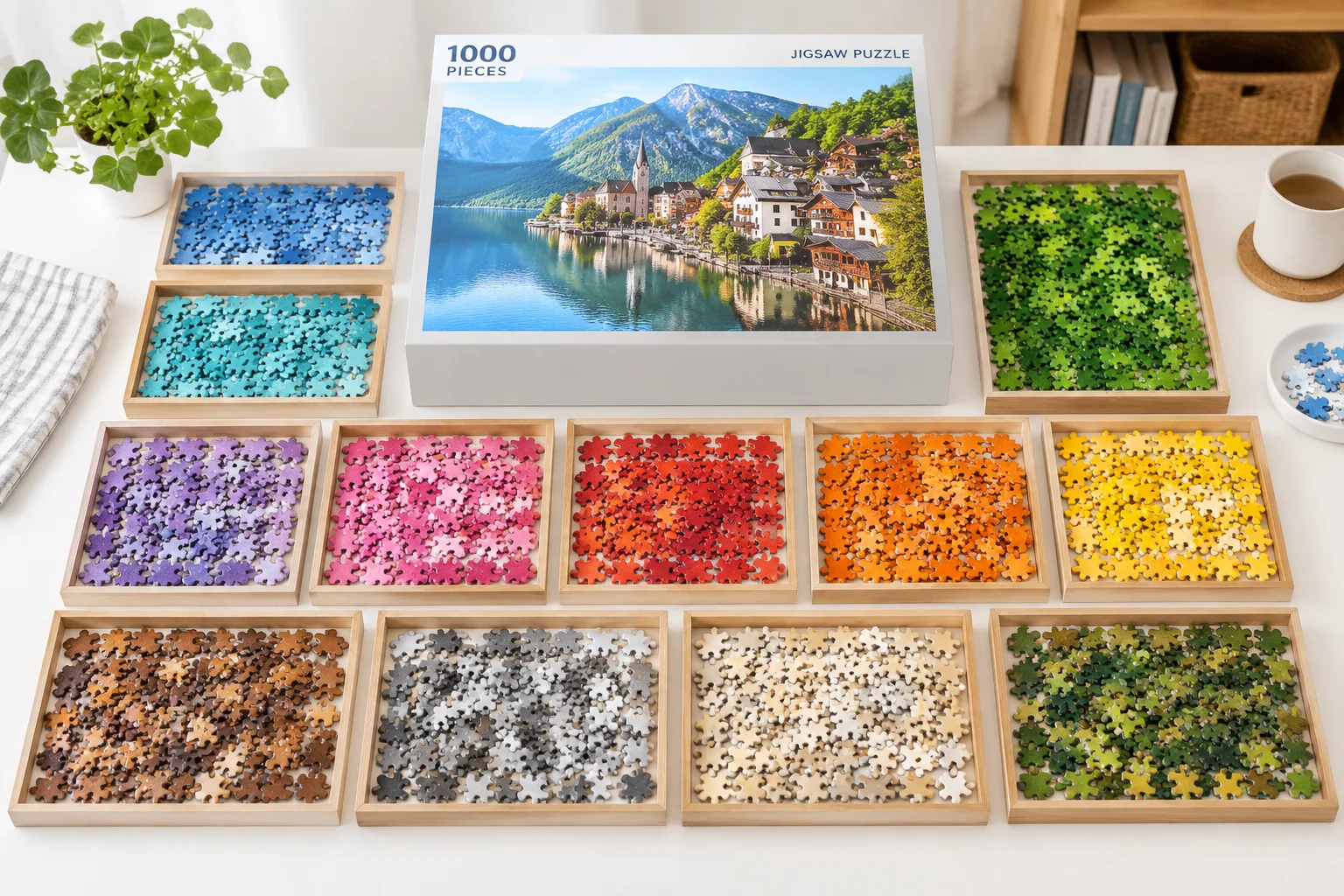
Ample table space prevents physical cramping and accidental dislodging of completed sections. A matte puzzle board paired with overhead diffused neutral lighting minimizes distracting surface glare across glossy cardboard or lacquered wood pieces. Spreading your pieces face up across dedicated sorting trays immediately separates border items, gradient bands, and standout graphic landmarks.
Speed in puzzling is not about moving your hands rapidly; it is about eliminating ninety percent of incorrect piece inspections before you even reach for the board.
— Michael Roberts, Senior Puzzle Designer
Strategic Sorting and Sequential Assembly Methods
Rushing into middle pieces without a strict organizational framework quickly stalls momentum. Veteran speed puzzlers divide their approach into clear tactical phases:
- Perimeter extraction: Pull every straight-edge piece during your primary sorting pass to construct the exterior boundary frame without hesitation.
- High-contrast grouping: Assemble bold visual anchors such as typography, architectural lines, and bright focal characters before tackling subtle gradients.
- Secondary sorting by geometry: When colors become identical, sort remaining pieces into small grid arrays oriented in uniform direction by knobs and holes.
- Negative space alignment: Observe the silhouette of the empty slot rather than the piece itself to instinctively recognize the corresponding puzzle tab.
Overcoming Difficult Monotone Sections
Large swaths of open sky, deep forest canopies, or calm ocean water frequently slow builders to a crawl. In these zones, color cues provide minimal guidance. Arranging pieces in neat rows facing the same north-south orientation allows your eyes to rapidly scan for unique cut eccentricities, asymmetrical shoulders, or elongated tabs.
Take deliberate five-minute breaks when eye strain sets in. Stepping away resets your visual acuity, making previously overlooked color gradients and microscopic texture nuances leap out instantly upon your return.


Eleanor Vance
Verified BuyerThe craftsmanship on this piece is breathtaking. The precision of the interlocking joins and the tactile feel of the warm finish surpassed all my expectations. Worth every single penny.